Showing posts with label Marketing. Show all posts

Wednesday, 22 November 2017

If you deliver a consistent product, place and promotion don’t matter much

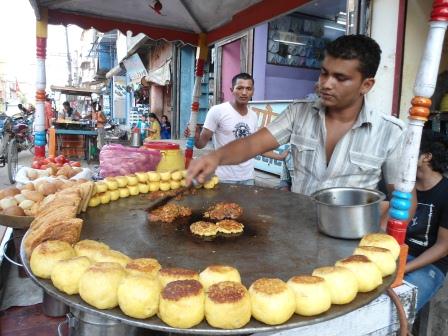
The chicken leg pieces are lip-smackingly good.

The other day, I was going gaga over the accessibility factor to make your products reach more and more customers. And I fell flat when I visited this eatery in a remote corner of Mid-Western Nepal.

And let me share with you this gem of wisdom: You don't need to be stationed at an accessible place if you deliver consistent taste to your customers!

Puri Leg Pieces, a small eatery at an awkward place, defies all the theories of marketing. This restaurant is located at Khairapur which is almost an hour's drive from Nepalgunj in Mid-Western Nepal and the roads aren't great either. However, people flock to this place to taste the chicken leg pieces, fried in cooking oil with spices added to enhance the taste. They serve the pieces with tomato chutney and let me tell you it's amazing!

The lady running the place said, "We sell 40 chickens and make 50,000 Nepali rupees ($ 500) every day." They have introduced some interesting recipes which isn't found at other places. In addition, they make money from selling liquor and beverages.

Her family migrated from the hilly district Dailekh to Bhurigaun in Bardia some 10 years ago and they had rented the space with a small building in Khairapur to run their business.

When I asked about the recipe of her success, she said, “It’s all hard work and the consistent taste is paying off.” But she didn’t divulge her trade secret. “Does Cocacola share its secret?” she asked.

Within an hour’s stay at the famous Puri Leg Pieces, I deduced these nuggets of knowledge.  

Quality product is the key to attracting customers. It should be different than what others are offering in the market. Something ‘out of the box’!

Consistency of the product is another step towards success. The customers come to you for that special attribute of your product.

Ability to deliver the demand is a must trait to retain the customers. If they come to you and you’re not able to cater to their demands, they won’t return again.

Controlling the willingness to grow is another factor that will always help your business grow with time. It’s always good to have a bigger pie in the industry but you must be sure that you’re well established before you spread your wings. I remember the wise words of the lady at the restaurant. She said, “Ghati herera had nilnu (meaning: cut your coat according to your cloth).

Trade secret is something you’ll need to maintain although it’s all about sharing in today’s world. Why in the world would anybody come to you if they find the same thing everywhere?

Word of mouth advertising is still the best way to sell your products. People have returned to the ‘referrals’ and it’s still a huge hit in this age of social media boom.

Tuesday, 27 December 2016

Have your ever thought about these hidden messages in brand logos?

Designers and advertisers are creative, crazy and cryptic. And while designing a logo for a brand they try hiding some key messages in the logos. Not always, but they try their best to do it!

So why do they do it?

As Thompson’s rules of ad-making say, they try to do something different; they draw; and they train their eyes to see. They see patterns in everything they glance at.

And that’s why they try to hide messages related to the product in the logo, attracting the subliminal mind to the product.


Some of the most talked about brand logos with hidden messages are FedEx, Amazon, Toblerone, Baskin Robbins among others.

If you look carefully between the ‘E’ and ‘x’ in the FedEx logo, you’ll see a white arrow pointing to right. It signifies forward motion.

In the Amazon logo, a yellow arrow runs from ‘a’ to ‘z’ trying to say that they sell everything from A to Z.

In the Toblerone logo, you’ll see a dancing beer in the mountain. It has been dedicated to Bern, the city of bears, where the chocolate was developed.

Now look at the Baskin Robbins logo. The pink and blue ‘BR’ has pink ‘31’ hidden in it. It denotes the 31 flavours the ice-cream brand offers – one for each day in a month!

Want to know more?

Here is a list of brand logos with messages hidden inside them. 

Thursday, 10 December 2015

Don’t risk your reputation on rude front desk staff

Teach your staff to be polite. Flickr image by user KoiQuestion. CC BY-SA 2.0

Recently I was at one of the famous guest houses in Thamel of Kathmandu to meet one of my friends from India.

He had called me from the guest house landline and I could not grasp the room number correctly. When I asked the front desk staff, he fumbled through few pages, could not find the name and threw the ledger to me. I scanned through the pages but could not find the name.

The staff showed no interest at all to help. Instead, he claimed my friend might have lodged with some other hotel.

I took out my cellphone and showed him the number. Luckily, it was dialed from the guest house. Then the next person at the front desk came forward and checked in the computer’s log. And there he was – in the room no 308.

He dialed the room and handed me the phone. I thanked the man for his kindness. However, from now onwards I would never recommend any of my friends to stay there.
                 
                  ****                ****                ****                ****

A reputed bank in the heart of Kathmandu, known for its customer base and profitability, has no dearth of customers. However, one thing that it lacks and which makes its service sucks – is again, the front desk staff manners.

Recently, I was at the bank and was a victim of snobbish behaviour of a front desk officer at one of its branches in Maharajgunj. As I was in a hurry to collect the statement, I rushed to the twenty-something guy and asked him where I can get the statement. To my astonishment, he behaved with me as if I was a schoolboy asking him irrelevant questions. Not even looking at me, he pointed me to a teller and said, “Can’t you see, it’s written over there – in BIG letters?” And literally, he was pouring his frustration on me.

When I enquired at the counter, the officer once again politely pointed me to the same guy. I was miffed to be directed to the same rude officer. However, this time, he yelled the guy’s name and asked him to hand me the envelope.

As I got to the front desk, he asked, “NAME?” When I told him my name, within a minute, he took out the envelope, handed it to me and said, “Why didn’t you ask me to search the envelope?” And again he was rude as earlier, as if I had asked him to fetch the three golden apples.  

Dumbfounded, I returned from the bank and decided not to continue banking with them.

                          ****                ****                ****                ****

Incidents like above happen all the time – even at so-called reputed organisations. And they only bring bad names to those organisations. In the past, nothing much happened to such rude front desk staff and the organisations. However, things have changed and with the return of word-of- mouth era along with the advent of social media, the customer base can deplete in the blink of an eye.

Few months back, one of my seniors bought a pair of shoes on sale from a reputed store in Durbar Marg. As he reached home and found some defects, he went back and asked for a replacement. However, the shop owner didn’t listen to him. Vexed by the irresponsible behaviour, he clicked a picture of the shoes and posted it on Facebook detailing how he got cheated. Within minutes, everybody was cursing the storekeeper. The post went viral. You can imagine how many customers the store lost to that silly mistake.     

                            ****                ****                ****                ****

Now let’s again talk about the two incidents of irresponsible behaviour of the front desk staff. Replace myself with an angry customer. Then add the power of word-of-mouth and social media. With every tweet and every comment, the customers would have cursed them and asked their friends not to deal with them again.

With the popularity of social media, the power to promote and of course, to demote is controlled by the mere fingertips of customers. And believe me, most of the times, there is no involvement of the brain! It can either enthrone or dethrone you within seconds. 

Remember, customer relationship starts at your organisation’s gate itself. If you want to keep yourself ahead of the competition, make sure to train your guards and front desk staff to treat every customer with politeness. 

Who knows what tomorrow will bring. Wouldn’t you prefer a celebrity posting a selfie with your sweet and polite janitor?

The names have not been mentioned to protect the identities.        

Further reading
Protecting Your Company’s Reputation From Employee Risk

Here’s a paragraph from the above piece.

In Deloitte’s 2014 global survey on reputation risk, it was revealed that over half of the high-level executives surveyed believed that their biggest risk to company reputation came from its internal staff.

Sunday, 8 February 2015

Smart ways to ask customer feedback and referrals

Recently while I was in Cebu, Philippines, I noticed some smart and honest ways of asking customer feedback and asking for referrals.

Being a public transport user, I have never been asked by any of the drivers how their driving is. However, while riding a jeepney, a long form of tuk-tuk or tempo in Nepal, I was happy to see a message asking about the drive. At least they considered about the passengers!

On the side of the jeepney was the message - “How’s my driving? Tel. No. …..”.


What a smart way of caring customers and asking for feedback? Because of the message I was tempted to ride a jeepney again and again instead of taking taxis.

In another incident, along with my friends, I was dining at a local restaurant. The restaurant was neither fancy nor a laid back sort of. The food was okay and the service was alright. However, the most fascinating thing about the restaurant for me was a message on its wall.

“If you like our food, tell someone. If you don’t, tell us.”

They had also provided numbers for texting comments to.


That’s what I liked about the restaurant most and when I returned to the hotel, I recommended my friends to go to the restaurant and taste the food.

So, if you are doing a business, never ever shy away from asking customer feedback and referrals. It helps you rope in more customers and develop a loyal customer base.

Tuesday, 18 February 2014

Courtesy and employee commitment - a must for customer loyalty

Deal with your customers courteously (c) www.morguefile.com
Recently I was at one of the famous guest houses in Thamel of Kathmandu to meet one of my friends from India.

He had called me from the guest house landline and I could not grasp the room number correctly. When I asked the front desk staff, he fumbled through few pages, could not find the name and threw the log book to me. I scanned through the pages but could not find the name.

The staff showed no interest at all to help. Instead, he claimed that my friend might have lodged at some other hotel.

So I took out my cellphone and showed him the number. Luckily, it was dialed from the same guest house. Then the next person at the front desk came forward and checked in the computer’s log. And there he was – in the room no 308.

He dialed the room and handed me the phone. I thanked the man for his kindness.

When we left the place, we asked the gatekeeper directions to a well-known pub. But instead of helping us, he behaved like a self-satisfied snob. There was no politeness and not even a pinch of humility in his tone of voice.

As a result, my friend from India said that he would not stay at the guest house from now-onwards. And I promised not to recommend any of my friends to the guest house.

Thus, here goes the first nugget of wisdom to retain customer loyalty.

Customer relationship starts at your organisation’s gate itself. Conduct training on courtesy and etiquette for all staff starting from the gatekeeper and front desk staff. And apply zero tolerance on compliance.

In a recent webinar titled “Creating a sustainability innovation culture in your organisation: Employee engagement 2.0”, Christine Diamente, Head of Brand and Corporate Sustainability at Alcatel-Lucent, explained how the company ensures same culture in all countries across the globe. Alcatel-Lucent applies zero tolerance on compliance and conducts compliance training for all employees across the globe, as well as contractors and subcontractors.

***            ***            ***            ***

Few days ago, as I was passing by a state-owned dairy products outlet in New Road of Kathmandu, I thought of picking a packet of paneer. So I went inside the shop and asked for a 200 gram packet. As the lady gave me the packet, I handed over a 500 rupees note to her.

To my astonishment, she took back the packet from me and the man sitting next to her bluntly said that they don’t have the change.

What a nonsense! They had the product, there was a customer ready to buy, but they did not have willingness to sell it.   

It not only miffed me, but even tempted me to look for other options. Though I was a loyal customer of the dairy, I bought a competitor’s product. And it tasted equally good!

Thus, the second nugget of wisdom to retain customer loyalty goes like this.

Come up with plans to ensure employee commitment. Embed sustainability within the employee culture. 

In the earlier mentioned webinar, Sarah Ellis, Head of Corporate Responsibility and Society at Sainsbury’s, said that sustainability is embedded within the employee culture at Sainsbury’s. They have come up with 20x20 Sustainability Plan with 20 commitments based on five corporate values to make them an even more sustainable business by 2020.

At Sainsbury’s colleagues with innovative ideas are rewarded. “Little stories, big difference” videos showcase employee efforts in engaging customers to advance 20x20 goals at Sainsbury’s.

***            ***            ***            ***

The webinar, Creating a sustainability innovation culture in your organisation: Employee engagement 2.0, was organised by Ethical Corporation on 12 February 2014. The names of the organisations have not been mentioned to protect their identities.

Tuesday, 10 September 2013

Ads, Hindu gods, goddesses and controversies

 In advertising, what sells apart from sex? Elegance, charisma and wit.

On the contrary, a recent campaign created by the ad agency Taproot India shows the most revered Hindu goddesses Laxmi, Durga and Saraswati as the victims of domestic violence. Laxmi, the goddess of wealth known for her elegance has a swollen lip and cut on her nose. The goddess of strength Durga's charisma is shadowed by cuts on her forehead and cheek. And the goddess of knowledge Saraswati's wisdom is marred by a bruised eye and blood-dripping lips.


"Pray that we never see this day," the ads read. "Today, more than 68% of women in India are victims of domestic violence. Tomorrow, it seems like no woman shall be spared. Not even the ones we pray to." The ads have gone viral and blogs and online portals are awash with news and comments on the ads.

The "Abused Goddesses" campaign images were created by mixing modern-day photography using live models with traditional hand-painted Indian art. They were commissioned by Save the Children India for its Save Our Sisters initiative, which, works to prevent the sex trafficking of young girls and women.

While the campaign aims to shock and horrify the audience with its powerful text and images, a large segment of Hindus still don't want to see their goddesses abused. 


Earlier, Burger King had issued an ad showing Laxmi, along with one of the beef burgers, which are forbidden under Hindu religion. The fast food chain was forced to withdraw the ads from its stores in Spain owing to the hue and cry of Hindus across the world complaining of the denigration of their religion.

 
In a similar move, the ad agency Saatchi & Saatchi used images of Hindu gods in their advertising for a Goa tour operator, Cox & Kings. In the ads, Goddess Laxmi was shown sitting next to a chubby kid eating wafers, and Lord Hanuman was shown taking pictures with a camera. After Hindus ransacked Cox & Kings' office, the company ran a front page apology in a local newspaper apologising for the ads and blamed the agency for publishing the ads without its consent.
 

Likewise, designer and model Lisa Burke infuriated the Hindus during Australian Fashion Week Spring/Summer 2011/12 in Sydney when she presented a swimsuit featuring Laxmi as a part of the latest collection of her Lisa Blue label. After protests across India she announced a halt in production and vowed that the Laxmi swimsuit would never make it to stores.
 

In 2012, Burnside Brewing Company, a Portland-based American brewery was to launch "Kali-Ma Beer". Owing to protests from Hindus, the company postponed the limited release of "Kali-Ma Beer". The beer was earlier announced as spiced wheat ale involving cardamom, fenugreek, cumin, India dandicut peppers, etc., and showed the picture of Goddess with six arms and three severed heads.

In William Bernbach's words, "Advertising is fundamentally persuasion and persuasion happens to be not a science, but an art." However, to cut the long journey short, the advertisers are lured to creating controversies to persuade the consumers to buy the products. And what's easier than manipulating imagery of gods and goddesses to hatch a controversy? That's also an art. 

Photo credits:
Abused Goddesses campaign (c) scoopwhoop.com
Burger King ad (c) EUROPICS
Model with Hindu goddess on the swimsuit (c) Mark Nolan/Getty Images

Monday, 26 August 2013

Business lessons in the rainy season

(c) www.morguefile.com
Rain dripping from your window sills, a melange of bright coloured umbrellas passing through the street, a rainbow bridging two seemingly far points and earth's sweet smell emanating from the first downpour of the season – it's what makes the rainy season so special. In spite of the mud, filth and deluge I love the season. As the rainy season comes to an end, I am reciting few lessons that I learnt during the wet, drippy days.

Pond herons and the bamboos
Aim for the tallest, highest and strongest.

I have a pond in my native village. The northern part of the pond is surrounded by bamboos and Indian Rosewood (Dalbergia sissoo) trees. During my village stay I spend an enormous amount of my time on the pond's embankment. And when I am there, I am engrossed in observing the birds coming to drink water and fish in the waters. In the evenings, I see hordes of pond herons flying back to their nests on the bamboos. It's interesting – they build nests on tall trees and bamboos, and while resting they prefer to perch on the bamboo tops.

This must be the reason – it's easy for them to land on the bamboo and tree tops while flying. The pond herons convey a simple message to us – always aim for the tallest, highest and strongest.  

Crabs and fishes
Don't waste time pulling others' legs, instead leapfrog.

Once I collected almost dozen crabs and few fishes from a freshly ploughed field in a small bucket. Not to let the fish die, I also added handfuls of water to my catch. While I was on the way to home, almost all the fishes had jumped off the bucket and I had just a single fish left in the bucket. However, none of the crabs had escaped.

When I reached home and tried to pull out a crab from the bucket, two more crabs clung to it. I left all the crabs in the bucket and observed them. Once a crab started climbing up the bucket, another clung to its feet and both of them were again back at the bottom of the bucket. None of the crabs were able to climb out of the bucket in my half an hour's scrutiny.

They offered me a valuable lesson – never waste time pulling others' legs, instead leapfrog if you want to succeed.

Eagle and fish
Set your sight on the target, forget the fear of failure.  

There are four public ponds in my village. All of them have been leased out to traders by the villagers for fish farming. The traders harvest the fishes at least twice a year. During the fishing, the whole village gathers at the site. Children run alongside the fishing nets to collect the fishes that jump out of the net, and men and women wait for their share of the catch. Each household gets at least a kilo of fish as a token of their ownership over the ponds. While the people are busy catching fish, eagles hover in the sky in search of a chance to catch a fish that escapes the net.

The eagles are such precise creatures that they keep on flying hundreds of feet above the land looking for a chance to pounce upon a fish escaping the net. And I have seen many a times, they are successful in running away with big catches. The moral is – set your sight on the target, forget the fear of failure.        

Fishes and the water-flow
Rise against the current.

During the rainy season the paddy fields are full of water and fishes. While draining away the excess water from the upstream fields to the downstream fields, the farmers put handmade traps between the fields to catch the fishes. The fishes are simply swept away by the running water and get entangled in the traps. There are fishes which never come near the water flowing downstream. However, if you observe carefully, there are fishes which flow along with the current but swim back as and when they approach the trap.

That's the way we should be. We should take risks but stay away from being a foolish risk-taker. And if possible rise against the consequences and come as a winner.

Wednesday, 26 September 2012

5 Cs of consumer behaviour

Recently I travelled to Nepalgunj, a city in Western Nepal famous for its chat (a spicy mixture of potato, onion, chilly, curd, tamarind and spices), rabri (a form of condensed milk) and sekuwa (grilled mutton chunks). I was alone and it gave me freedom to roam the streets and observe the consumer and trader behaviour.

Clustering attracts customers
As I approached the Tribhuvan Chowk, the street that is famous for chat, I could see hordes of food carts selling the delicacy. Even the surrounding shops were catering to the demands of the customers. They were also selling chat. It is really helpful to have a street full of sellers selling same commodity. One doesn’t need to wander here and there in the city in search of the required material. The benefit of clustering together is – the customer has many choices to choose from. So, it attracts the customers in first place. In case of sellers, they don’t need to wait for customers in an obscured corner, but the customers come to the street looking for them. It is like being part of the fraternity selling similar things.

Caring for the crowds
Having a plethora of choices, I moved on to a cart which was surrounded by many eaters. It is a human psychology to believe in the crowds. It provides live testimony that the seller is selling quality products. A seller needs to care for the crowds and for every single customer in the crowd. If s/he is able to satisfy the demand of the customer, the crowding-in continues. It is not only word of mouth publicity but I would rather say sight for eyes advertising.  

The chatwallah knew all Cs of consumer behaviour.
Catering to the customer’s needs 
On reaching the food stall, I was greeted by a warm smile of the vendor. He asked me to wait for my turn gracefully. A duo of father and daughter had arrived earlier than me and he was catering to their needs. I was the next in the line and it was my turn within few minutes. I didn’t hate waiting for my turn due to his friendly and warm behaviour.

Clean and clutter-free ambience enhances the mood to buy
In spite of being in a busy street, the disposable plates and spoons were clean, the stall and the handler both were neat and tidy. Above all, the delicacy was hot and spicy, fresh from the frying pan. I gulped down the chat within a minute. It was very delicious as recommended by my friends. I sensed that the cleanliness and clutter-free ambience amplified my desire to eat.    

Caring your customers builds loyalty
When I was leaving the stall, the vendor asked me with a smile, “How was the taste, Sir? Did you like it?” I told him that the taste was terrific. He then requested me to visit again. That was the reason to visit his stall again and savour the tasty chat prepared by him.

I was satisfied in every way – I got to eat the delicious chat, was treated like a royal and above all, the experience reinvigorated the consumer behaviour theories remaining stagnant in my grey cells!   
 

Saturday, 14 April 2012

5 proverbs, 4 animals and marketing lessons

You must have noticed that adding proverbs while discussing makes the discussion not only lively but also adds spice to the language. It helps you clarify your views, makes your opinion more specific and adds impetus to what you are saying. I prefer to say that proverbs are chutneys, the hot and spicy mixture which adds spice to your otherwise plain food.

Many proverbs originated from different animal behaviours and their relationship with humans. While all animal related proverbs guide us to better living, quite few of them teach us important marketing lessons.

There is more than one way to skin a cat
The proverb means there is more than one way of achieving an aim. You can employ different approaches to market a product and eventually build a brand. As Philip Kotler suggests, depending on your market plans you can either go for entrepreneurial marketing based on direct selling and grassroots public relations, formulated marketing with a marketing department and salespeople or intrepreneurial marketing adopted by large companies where brand and product managers study consumer behaviour and visualise new ways to add value to customers’ lives.

Don’t put the cart before the horse
It means don’t reverse the accepted order of things. First create a world class product, then market it and advertise in full swing. If you do it the other way round, you will not only lose money but also the faith of the consumers.

Don't change horses in midstream if you want to succeed.
Don’t change horses in midstream
The proverb means don't change your basic position when part-way through a campaign or a project. Once you start building a brand, don’t lose your patience in the mid-way. If you start marketing apples, don’t leave it owing to losses and start selling oranges.

A leopard cannot change its spots
The proverb means things cannot change their innate nature. As in the case of leopard, a brand too can’t change its true form. A brand should stick to its origins. You can’t imagine of a Mercedes ice-cream or a KFC car. However, a McTikki as a sub-brand of McDonald’s can attract consumers.

Every dog has its day
It means every dog, and by implication every person, has a period of power or influence. It tells us to wait and persevere because brand is not built in a day. It requires continuous dedicated effort to create a brand in the hearts of consumers. People will get to know your brand if you keep on delivering consistency and adding value to your product gradually.

Tuesday, 28 February 2012

Leave aside USPs, interact with consumers

Gone are the days when the consumers had no choice than to clinging to daily newspapers, listening to radio stations or watching television. Now the choices are abundant – you will find newspapers and magazines of all sorts ranging from sports to economics; name any field and you will find loads of glossy papers rolled out with flashy pictures and heavy content. Talking about television – as in case of newspapers – the channels cater to all genres of interests. In case of radios, there are hordes of stations, playing per request. While the traditional media have grown by leaps and bounds, the new age media – microblogging and social networking have spread their tentacles in the hearts and minds of consumers.

 
USP versus contextualisation
Once it ruled the integrated marketing communication (IMC) plans. Each product was uniquely positioned in the market to win the hearts of consumers. The unique selling proposition (USP) of a product depended on the public persona of the targeted consumers.

However, the tables have turned with time. The product marketers are reading and analysing consumer behaviour to design their products accordingly. “If the USP ruled earlier, brands now need to create movements, experiences and engagement with consumer,” says Bindu Sethi, the Chief Strategy Office of JWT India, in Brand Equity, the special edition of The Economic Times. “The world is more interactive and we need to respond.”

Dhiraj Sinha, Regional Planning Director, Asia for Bates says, “In today’s world, brands need to provoke debates and engage people, and this needs a very sharp understanding of what’s changing in the culture and how people are behaving differently.”

Your brand needs to highlight the aspect of interaction with locals and develop new slogans reflecting the different product features. You now need to adapt your brands to target the major source markets.

Go online, interact with consumers
The internet has become a common platform for both the marketers and consumers. It is considered as the most important source of information by consumers. Official product websites are important point of information for consumers. Media and specifically online advertising can be powerful in creating consumer awareness and attracting them to the product websites. Social networking sites as well as specific product-related blogs, open forums, online guides, wikis and consumer communities are fast emerging and provide opportunities to initiate positive word-of-mouth publicity and strengthen brand recognition and loyalty.

Follow the below steps to start interacting and engaging with your consumers online.

 
  • Assess and review your current website regarding usability, graphic user interface, content, structure and marketing message and implement changes where necessary.
  • Develop website content for special-interest groups.
  • Develop an online communication plan to promote your product website and implement search engine optimisation (SEO), search engine marketing (SEM) and backlinking activities to secure better ranking and promotion of the product website online.
  • Constantly update content to keep the website appealing to users; match any content with the marketing messages.
  • Prepare a list of potential online advertising platforms and invest on them wisely.
  • Identify relevant social media networks and communities, blogs and forums and develop a social media plan.
  • Analyse popular networks and work on enlarging the Facebook community through constant updates as well as fun and participatory elements such as competitions, pictures, videos, feedback loops on posts, etc.
 The constant touch with your consumers will give you clear idea of steering your marketing strategy accordingly, rather than sticking to a stubborn USP for a certain period. Go ahead and indulge in the online world and know your consumers better!


 *The social media logos have been downloaded and adapted.


Monday, 23 January 2012

Do you still like teaser advertisements?

You get joy out of making people wait, guess and predict. Meanwhile the respondents test their IQ and feel proud to guess what you are talking about. In the past, advertisers took advantage of this human trait to launch new products, associate their products with the customers’ interests and refresh their brand identities.

The cat and mouse game
You must have been witness to advertisements in dailies that ask you to look at the same place again the next day. The next day you are again requested to do the same. With each day the curiosity inside you increases till it plateaus. And when you think that you are not going to do the same next day, the advertisers cleverly put forth their messages, making you part of their campaigns. You become so involved with the product that you try it at least once. If the product delivers your expectations – you are glued to it – turning into a loyal customer.

I would like to cite the example of launching of a tea brand “Tokla”. The advertisers put hoardings and banners with the message “Kala is coming” for few weeks, all over the marketplace, in the streets and major thoroughfares. The message was there in the daily newspapers as well. People kept guessing and speculating what the thing “Kala” was. On the stipulated date, the marketers revealed the new brand of tea “Tokla”. The brand was an instant hit. Owing to its good quality, the brand has still maintained a string of loyal consumers.

However, things have changed with the fast paced lifestyle. In the current rat race for moneymaking and enjoying life to the fullest, people easily get impatient. They don’t have time to look at the same place of the newspaper day after day. So, if you are a clever marketer, you know that people are not going to ply with your playing the “cat-and-mouse game”. Some might be interested till the second or third day, but from the fourth day onwards, almost everybody will have lost interest in your message.

Filling the gap between curiosity and patience
The marketers have again come up with innovative ideas to bridge in the gap between curiosity and patience of customers. Now you will find a set of teaser advertisements in a certain page of magazine or newspaper which asks you to turn on to the next page and at the end you are led to the introduction of the brand. This little teasing tantalises your brain and in a way you are more attached to the brand than others displaying the products one time only.

The advertisers have also come up with the idea of extension advertising (advise if you have better name), where they design different versions of the same advertisements with coherent message and a common tagline. The advertisements are generally displayed on the right hand side pages. As you turn the pages, the similar advertisements arouse your interest and you are led to the final advertisement which talks in detail about the product. Sometimes the products and the messages are revealed on the first page itself and similar, coherent messages are carried out by a set of advertisements that follow the first one, but of course with new visuals, graphics and colours.

The river returns to its original course once in 12 years
The trends keep changing with time and tend to return with some improvements within a certain time period. As goes the old proverb from the Indian subcontinent, “A river returns to its original course in 12 years’ time”, the marketing trends keep on being tweaked, adjusted, adapted and improved with time – landing up with the similar sort of campaigns which are marketers’ favourite at some point of time. However, for this time around, the teaser advertisements are certainly out of the scene.