Tuesday, 29 January 2013

5 ways to grow your Twitter following

Twitter is second only to Facebook in terms of users. It has 517 Million registered users with 6.9 Million daily active users. Every minute of the day 100,000 tweets are sent over internet and in a day 340 Million tweets make their way to the online world.

More than 11 Twitter accounts are added every second totalling to 1 Million new accounts created everyday.

Apart from tweeting and retweeting on a regular basis, you can grow your Twitter following through the below mentioned ways suggested by www.twiends.com.

Monday, 28 January 2013

Why to be a social media junkie

Why social media?

The social networking statistics and facts for 2012 speak a lot. If you are not there, you and your product will get lost not only in the online jungle but in the minds of the consumers as well.

The spread of social media is staggering. We end up sending 100,00 tweets, upload more than 48 hours of video in YouTube, share 684,478 pieces of content on Facebook and share 3,600 photos on Instagram every minute of the day.

Facebook has 1 Billion registered users with 552 Million daily active users. Similarly, Twitter has 517 Million registered users and 6.9 Million daily active users.

Each day Facebook users spend 10.5 Billion minutes (almost 20,000 years) on the social network. On YouTube, 4 Billion video views are seen globally every day.

Facebook is the number one social marketing tool for brands at 83% (88% target for 2014), followed by Twitter at 53% (target 64% in 2014).

Now can you imagine being out of the scene? If you are not there, just plunge in!
 
For more intricate and detail statistics and facts have a look at the infographics prepared by www.creotivo.com.

Tuesday, 25 December 2012

What is branding?

Let’s start with the American Marketing Association (AMA) definition. The AMA defines a brand as a "name, term, sign, symbol or design, or a combination of them intended to identify the goods and services of one seller or group of sellers and to differentiate them from those of other sellers.

However, a brand stands for more than that. It’s a set of values, experience, sense of belonging, and much more. Let’s understand it in simple words by simply running through the below video. It presents the basics of branding.


So, did you find anything new? I am sure you will say “it’s the same definition everywhere”. Now, let’s see what these people have to say about brands.

Stephen King of WPP Group, London distinguishes a brand from a product as he says, "A product is something made in a factory; a brand is something that is bought by the customer.” “A product can be copied by a competitor; a brand is unique."

Likewise, Marketing Guru Philip Kotler says, “If you are not a brand, you are a commodity.” Advertising Guru David Ogilvy simply puts it as - "Within every brand is a product, but not every product is a brand."

The creator of Revlon, Charles Revson also agrees with them when he says, “In the factory we make cosmetics; in the drugstore we sell hope." While Walter Landor of Landor Associates takes it to the next level when he says, “Products are made in the factory, but brands are created in the mind.”

Al Reis and Laura Reis, the authors of 22 Immutable Laws of Branding also connect the brand with consumer’s mind. They say, "A brand should strive to own a word in the mind of the consumer."

Jeff Bezos, the founder of Amazon personifies a brand. He says, “A brand for the company is like a reputation for a person. You earn reputation by trying to do hard things well.”

David Ogilvy adds the human experience to the definition of a brand. According to him, “Any damn fool can put on a deal, but it takes genius, faith and perseverance to create a brand.”

Stuart Agres, the Principal at Adduce Consulting and Owner, Adduce International Corp., links a brand to a set of promises. In his words, "A brand is a set of differentiating promises that link a product to its customers." While Harry Beckwith, the author of Selling the Invisible, draws in the trust factor when he says, “It is not slickness, polish, uniqueness, or cleverness that makes a brand a brand.” “It is truth.”

Talking about brands, consumers and brand loyalty, Edwin Artzt, the former CEO and Chairman of Procter & Gamble, says, “Brand value is very much like an onion.” “It has layers and a core. The core is the user who will stick with you until the very end.”

Brand has been compared with time. In Stephen King’s opinion, “A product can be quickly outdated, but a successful brand is timeless.” Creators and curators of brands die but a brand lives on, if managed well. In former Diageo Chairman George Bull’s words, “Well-managed brands live on – only bad brand managers die.”

Brand is a complicated story. Its innumerable connotations are never-ending. Scott Bedbury, an American Advertising Executive formerly associated with Nike, Inc. and Starbucks and the author of A New Brand World: Eight Principles for Achieving Brand Leadership in the 21st Century, says, “A great brand is a story that’s never completely told.”

Sunday, 16 December 2012

Choose right brand colours, connect with consumers

There’s something special about brand colours. Colours say it all - WWF’s black and white, Facebook’s blue, Twitter’s light blue, Coca-cola’s red, McDonald’s golden and red, and likewise other colours convey the psyche of a brand (read the article Colour communicates).

Rummaging through the webpages, I found this interesting article by Jason Miller talking about how different colours can help you connect with your consumers.


Read the original article True Colours: What Your Brand Colors Say About Your Business.       
 

Tuesday, 11 December 2012

Overuse brand colour at your own risk

Use brand colours wisely. (c) www.freepixels.com
I was overwhelmed by the red colour during the festive season of Dashain, the most important festival of Hindus. Everywhere there was red – little children wearing red dress, women wearing red saris, family members wearing red tika on their foreheads after receiving blessings from the elders and even the decorations in the marketplace – all were red.

It perfectly matched the adage, “Paint the town red”. Then I landed in this newly opened restaurant. I would not take its full name so that their marketing efforts are not jeopardized by my comments. It was named “The Red…..”.

When I entered, there was red and only red everywhere. The door was painted in red, the sofas, tables, chairs and curtains – everything was red. When the waiter came with the menu, not only its cover was red but even the inside pages were red. To my dismay, even the plate and cup were red in colour.

While eating, it felt as if the red colour will stick to my tongue. You can imagine what others have felt. The restaurant was well designed, located at a prime point in the marketplace, well promoted in the local media, and of course the dishes were delicious. However, I saw, the customer turnout was not so exciting.   

Talking about the use of brand colours, I can’t forget another example where the marketers have overwhelmingly used their colours to brand their product. It’s of NCell, a telecom service provider in Nepal. The marketers have not spared any nook and cranny in the country. They have painted with purple the flower pots, street lamp posts, bus stations, small restaurants, public parks and to my dismay even the national monuments. The roundabout of Kohalpur in the Western Nepal has been smudged with their brand colour. Seeing all purple in the surrounding, I was feeling as if I will puke purple!

I don’t mean that it’s bad to use brand colours and your logos in abundance. It’s what the marketers have done in the past to subconsciously attract the customers and influence their purchase decisions. But there is a limit to everything. Simply painting the surroundings with your brand colours won’t help your brand make its way to your customers’ hearts. Instead, they will be annoyed to see the same colour everywhere.

Use your primary and secondary brand colours wisely. Remember the saying “if you overeat sugar, it will seem bitter after a while”.  
 

Friday, 23 November 2012

5 organisational lessons from animals and insects

Have you ever thought of animals and insects teaching us to organise better and effectively market our products? In the last few weeks, I rummaged through research journals to delve into the animal and insect behaviour, and came up with some interesting facts fuelling some practical lessons.

Change your strategy to suit the market needs
Goat kids change ‘accents’ to sound like their peers: As “kids”, the goats mimic the sounds of their mother and siblings. But when they get older, they wander off to join social groups, or “crèches”, with goats their own age, changing their accents to sound like their peers.

Now let’s talk about the practicality of this trait. Once Facebook was only for college students and required .edu e-mail addresses in order to join. Many of its users preferred its “exclusivity” to the “generality” of other social networking sites like “Friendster” and “MySpace”. However, Mark Zuckerberg gradually changed the strategy of catering only to college students to accommodate more users and the rest is history.   

Stick to discipline and organisational culture
Ants mark violators for policing: Policing is a familiar mechanism for maintaining cooperative behaviour in human societies. This mechanism also operates in other animal societies. Among ants, the workers physically attack other workers that selfishly attempt to produce their own eggs, and by such policing keep the colony focused on cooperatively aiding the queen’s reproduction.

This teaches us to build a culture within our organisation and ensure it is strictly followed through the ranks in the organisation. At the end, it is the organisational culture that makes an organisation stand out among competitors and create a brand of its own. It creates a common ground for team members, reduces uncertainty, and contributes to a sense of continuity and unity providing a vision to the organisation. Like the ants, you need to make sure that the members’ shared values, beliefs and behaviours are guided towards a common goal and no one violates the rules.        

Concentrate your efforts on a particular value
Rhinos leave dung piles at a particular place: Rhinos are known for their habit of leaving dung piles at a particular place. Most rhinos use piles of dung to leave “messages” for other rhinos - nuances in the smell of dung can tell a rhino a lot about others in the area. Each rhino’s smell identifies its owner as unique - the smell is different for young vs. adult animals, for males vs. females, and females in estrus vs. non-reproductive females.

Likewise, don’t try to be everything. Follow certain values to establish an identity of your own. In their book “The Discipline of Market Leaders”, Michael Treacy and Fred Wiersma say, “No firm can be all things to all people and that a firm’s managers must clarify the value proposition, select a value discipline from one of three major choices and then build the right value-driven operating model to support that discipline”.

The three value disciplines that Treacy and Wiersma outline are:
 

  • Operational Excellence-where firms focus on price and convenience.
  • Product Leadership-where the emphasis is on creating products that consistently push performance boundaries.
  • Customer Intimacy-where firms cultivate deep relationships with their clients.

Target the decision influencers
Leapfrogging in lady beetles: Herbivores aggregate in habitats where their plant resources are optimal and avoid habitats where their predators are in abundant. The research has shown that lady beetles aggregate where their prey’s plant resources are best, even though they as predators make no direct use of the plants. This strategy is termed ‘leapfrogging’ because the predator’s attention skips over the adjacent trophic level to concentrate on the one that is two levels down.


While you are formulating your marketing strategy, not only focus on the direct buyers, the primary targets but also take care of the influencers. It’s the same old theory of a housewife influencing the husband and children influencing their parents during the purchase. Nowadays, with the influx of so many social media platforms, the decision influencers have grown by leaps and bounds. That’s the reason marketers are putting their efforts in getting the maximum number of “likes” in Facebook pages of their products and are trying their best to instigate the consumers to share the pages with their peers and friends.
      
Tell the competitors to stay away
Honeybees tell hornet predators to buzz off: Asian honeybees signal to their enemies - bee-eating hornets - to let them know they have been spotted. All the guard bees simultaneously vibrate their abdomens from side-to-side for a few seconds when a hornet approaches the colony. In the wild, this produces a spectacular "Mexican wave" of vibrating bees. Warned wasps would retreat from the colony and try to catch bees in flight instead.

Keep on admonishing your competitors by continually improvising your products. This not only keeps intact the interest of your customers and creates long term brand loyalty, but also makes the customers feel proud using the products. Take the example of Facebook. Its continuous improvement in terms of features, navigation and utility has not only helped it attract more than 800 million users but has also kept the competition at bay. 

I am sure there are many more animal and insect behaviour that give us clue to organise better. Please add to the list if you come across any such lessons.
 

Wednesday, 26 September 2012

5 Cs of consumer behaviour

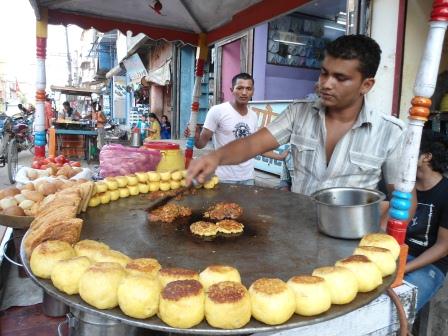
Recently I travelled to Nepalgunj, a city in Western Nepal famous for its chat (a spicy mixture of potato, onion, chilly, curd, tamarind and spices), rabri (a form of condensed milk) and sekuwa (grilled mutton chunks). I was alone and it gave me freedom to roam the streets and observe the consumer and trader behaviour.

Clustering attracts customers
As I approached the Tribhuvan Chowk, the street that is famous for chat, I could see hordes of food carts selling the delicacy. Even the surrounding shops were catering to the demands of the customers. They were also selling chat. It is really helpful to have a street full of sellers selling same commodity. One doesn’t need to wander here and there in the city in search of the required material. The benefit of clustering together is – the customer has many choices to choose from. So, it attracts the customers in first place. In case of sellers, they don’t need to wait for customers in an obscured corner, but the customers come to the street looking for them. It is like being part of the fraternity selling similar things.

Caring for the crowds
Having a plethora of choices, I moved on to a cart which was surrounded by many eaters. It is a human psychology to believe in the crowds. It provides live testimony that the seller is selling quality products. A seller needs to care for the crowds and for every single customer in the crowd. If s/he is able to satisfy the demand of the customer, the crowding-in continues. It is not only word of mouth publicity but I would rather say sight for eyes advertising.  

The chatwallah knew all Cs of consumer behaviour.
Catering to the customer’s needs 
On reaching the food stall, I was greeted by a warm smile of the vendor. He asked me to wait for my turn gracefully. A duo of father and daughter had arrived earlier than me and he was catering to their needs. I was the next in the line and it was my turn within few minutes. I didn’t hate waiting for my turn due to his friendly and warm behaviour.

Clean and clutter-free ambience enhances the mood to buy
In spite of being in a busy street, the disposable plates and spoons were clean, the stall and the handler both were neat and tidy. Above all, the delicacy was hot and spicy, fresh from the frying pan. I gulped down the chat within a minute. It was very delicious as recommended by my friends. I sensed that the cleanliness and clutter-free ambience amplified my desire to eat.    

Caring your customers builds loyalty
When I was leaving the stall, the vendor asked me with a smile, “How was the taste, Sir? Did you like it?” I told him that the taste was terrific. He then requested me to visit again. That was the reason to visit his stall again and savour the tasty chat prepared by him.

I was satisfied in every way – I got to eat the delicious chat, was treated like a royal and above all, the experience reinvigorated the consumer behaviour theories remaining stagnant in my grey cells!