Wednesday, 26 September 2012

5 Cs of consumer behaviour

Recently I travelled to Nepalgunj, a city in Western Nepal famous for its chat (a spicy mixture of potato, onion, chilly, curd, tamarind and spices), rabri (a form of condensed milk) and sekuwa (grilled mutton chunks). I was alone and it gave me freedom to roam the streets and observe the consumer and trader behaviour.

Clustering attracts customers
As I approached the Tribhuvan Chowk, the street that is famous for chat, I could see hordes of food carts selling the delicacy. Even the surrounding shops were catering to the demands of the customers. They were also selling chat. It is really helpful to have a street full of sellers selling same commodity. One doesn’t need to wander here and there in the city in search of the required material. The benefit of clustering together is – the customer has many choices to choose from. So, it attracts the customers in first place. In case of sellers, they don’t need to wait for customers in an obscured corner, but the customers come to the street looking for them. It is like being part of the fraternity selling similar things.

Caring for the crowds
Having a plethora of choices, I moved on to a cart which was surrounded by many eaters. It is a human psychology to believe in the crowds. It provides live testimony that the seller is selling quality products. A seller needs to care for the crowds and for every single customer in the crowd. If s/he is able to satisfy the demand of the customer, the crowding-in continues. It is not only word of mouth publicity but I would rather say sight for eyes advertising.  
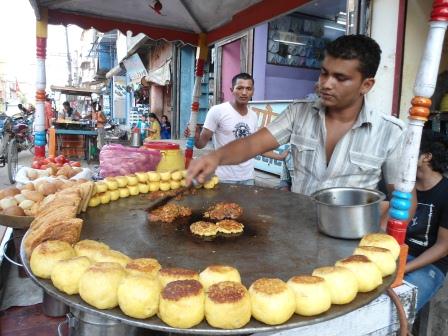
The chatwallah knew all Cs of consumer behaviour.
Catering to the customer’s needs 
On reaching the food stall, I was greeted by a warm smile of the vendor. He asked me to wait for my turn gracefully. A duo of father and daughter had arrived earlier than me and he was catering to their needs. I was the next in the line and it was my turn within few minutes. I didn’t hate waiting for my turn due to his friendly and warm behaviour.

Clean and clutter-free ambience enhances the mood to buy
In spite of being in a busy street, the disposable plates and spoons were clean, the stall and the handler both were neat and tidy. Above all, the delicacy was hot and spicy, fresh from the frying pan. I gulped down the chat within a minute. It was very delicious as recommended by my friends. I sensed that the cleanliness and clutter-free ambience amplified my desire to eat.    

Caring your customers builds loyalty
When I was leaving the stall, the vendor asked me with a smile, “How was the taste, Sir? Did you like it?” I told him that the taste was terrific. He then requested me to visit again. That was the reason to visit his stall again and savour the tasty chat prepared by him.

I was satisfied in every way – I got to eat the delicious chat, was treated like a royal and above all, the experience reinvigorated the consumer behaviour theories remaining stagnant in my grey cells!   
 

Tuesday, 12 June 2012

7 media trip essentials

Media trip is a time-tested tool for communicators to highlight the project successes. The journalists get to see and verify the first hand information, analyse the situation and report accordingly. You don’t need to put extra efforts to convince them to write on the subject.


Forming a small and diverse team
The team should be small – not more than seven members and should comprise journalists from all media: print, electronic and online. Make sure the journalists are from top ranking newspapers, television, radio and online portals.

Preparing a well planned itinerary
The itinerary should be planned well with all the meetings fixed ahead of the trip. The itinerary should be shared with the journalists well ahead. Make sure you set aside enough time for the real job and daily essentials like breakfast, lunch and dinner.

If your itinerary includes trekking or walking in rugged terrain, inform them of the duration and landscape. They will be prepared for it accordingly.

Briefing about the project
The journalists should be briefed well ahead of the trip. A backgrounder with all project details should be forwarded to the journalists at least a week ahead, so that they are well informed on the subject. Brochures, booklets, flyers and relevant project publications should be provided.

Besides, they should be informed of the weather and things to carry with them. They should also be informed about the tradition and culture of the place, so that they don’t end up dishonouring the local people and their culture.

Sticking to the story angle
The story angle should be decided well ahead and the coordinator should stick to it. The itinerary should be based on the story angle and the interviews should be scheduled accordingly. Meanwhile the journalists should be convinced to disseminate the story in the same way.

They will, in the most cases, highlight the humane interest stories. However, you should be careful enough to link your project objectives in the stories in a subtle manner.

Treating the participants with dignity
Treating the journalists well is a must. They should be made to feel at ease. However, the professional boundary should not cross the personal limits.

The stakeholders with whom the journalists will meet should be informed of the meeting in advance and they should be briefed ahead of the publications/channels they represent.

Following-up for stories
The journalists are busy with so many assignments and stories. You need to follow-up but in the mean time must make sure that you are not pushing them to publish the stories.

Sometimes they take time to gather the relevant information needed for their articles. Also you’ll need to check the statistics with the journalists. Sometimes the facts are exaggerated and in some cases under-reported.

Following-up for future relations
Just taking the journalists to the field, getting the stories published and closing the chapter is not enough. Relationship building is a must for future.

Once the journalists are interested in the issue, they will continue to write on that topic. However, they will need some leads to the stories. You will also need to pitch your interesting stories from time to time to get them published at regular intervals.

Wednesday, 30 May 2012

9 Es of Advertising

Ernest Vincent Wright might have written the novel Gadsby: A Story of Over 50,000 words without Using the Letter “E”, but it is not possible to advertise without considering the Es. Having worked and being heavily involved in the advertising industry, I could not keep myself mum when I went through an article in an Indian magazine 4P which dealt with 5 Es of Advertising (Engage, Empower, Educate, Entertain and Enrich). I have added few more Es to the list and poured in my views on each of the Es. I hope you would find them interesting.

If you have experienced more Es in advertising, you are welcome to add to the list. Here goes my list of Es.

Engage
Engaging with the consumers should be the prime focus of the advertisement. If you don’t engage with your prospective and current consumers, then you are losing their insights, suggestions, inputs and feedback to you and your product.

You must have seen the message in the bottles and packs of consumer items with the toll-free number and email ID for consumer feedback and suggestions. It was the only way to interact in the past with the consumers.

Now you have got Facebook – create a fan page of the product and interact with your consumers. A Twitter account will help you get your message regarding the product to your consumers who follow you and your product. The Pinterest boards are also gaining popularity where you can display your products and their attributes.

However, just being in the social media platform is not enough, make sure that you are there to interact with the consumers, reply to their queries in real time.

Educate
There’s more than engaging with the consumers. Educate them, but make sure not to be a teacher. A blog about the product, its features, and its benefits will attract more of your consumers to your product, provided you are offering what you are preaching.

If you are launching your product that is ahead of time, you need to make sure that the consumers are educated about the product. It’s a must. I remember eating dumplings in a Delhi restaurant “Belle Momos” a long time ago. At that time, the proper Delhites were not used to eating dumplings. So, to educate them they had hung framed advertisements teaching “how to eat momos”. It was hilarious for dumpling fans like me but was an eye opener for the starters.

Empower
Make the consumers feel that they have a stake in their favourite product. Listen carefully to what they say, what they suggest and don’t even leave behind any crazy suggestion that comes your way. Some of them might lead you and your product to innovation which your competitors might not even think of.

Many fast moving consumer goods (FMCG) are coming up with innovative advertising campaigns empowering their consumers, in the process building brand loyalty. Earlier this was restricted to the FMCGs asking for recipes from the consumers and putting the snaps of consumers on the packages (Remember the Kurkure and Maggi campaigns?).

Now crowdsourcing has gained momentum, not only in raising money and for a cause, but also for collecting individual opinions and advices on a subject. Summarising the opinions and views and picking up the best can lead to innovative ideas to reckon with.

The Times of India’s Lead India campaign was highly successful in motivating the youth to becoming leaders to change the fate of the country.

Enrich
Enrich the customer experience. Make them walk along with you while you are advertising and building the brand. It all depends on how you communicate the experience behind the product you are offering.

There’s a famous Nepali bottled water brand “Aqua Hundred”. In its advertisements it asks the customers to visit the factory premises and observe how the water is purified. This gives not only a sense of security to the consumers but eager ones can see on their own how the water is made safe for drinking.

Entertain
Make your advertisement interesting and make sure it entertains the audience. P S Mann, the Creative Director at RR Swamy BBDO in an interview to 4P says, “If an advertisement is just an advertisement, the consumer will develop a defence mechanism and not watch it.” “So it’s extremely important to deliver entertainment. Engagement comes from entertainment and from entertainment comes attention.”

To entertain the consumers you should create advertisements which are original, interesting, creative and of course entertaining. Just have a look at the Fevicol advertisements created by Piyush Pandey and you will get an idea of what entertaining is.

Evolve
Evolve with time. Change is the name of the game. Be aware of the ambience and what your competitors are doing and offering. You must be able to change yourself accordingly. Creating an advertisement with old setting won’t work (It might work sometimes but only for a short duration).

Use the modern techniques, tools and medium to reach the audience. Rise above the above the line and below the line advertising. Target cloud advertising – get online and attract the online customers.

Empathise
Have you ever wondered why the guy in the television advertisement resembles you? Because the advertisers are targeting the customers like you! Study the demographics, psychographics and lifestyle of your target audience and create your advertisements according to their tastes, interests and aspirations. They will like your product if a character of their class is shown preaching about the product.

Evaluate
Evaluate your efforts and redo the campaigns and advertisements to suit the customer preferences. Do the cost-benefit analysis and pour in more money sensibly if your efforts are not generating customers.

There is no dearth of crazy people with ideas these days. With decent spend you can get a good team of creative people who can come up with compelling campaigns.

Entice
Last but not the least, don’t leave any stones unturned to entice your customers. This doesn’t mean that you should splash skin all the time like all the deodorants do. Sex obviously sells but it should not be made the main means to attract the customers all the time.

Leave no stone unturned to entice your customers.
You must have heard that a poor guy sued the deodorant “Axe” after he wasn’t able to attract any girl after spraying it all over himself. However, the help of sensuousness can be taken to advertise your product like the “Aamsutra” campaign which shows a Bollywood actress (Katrina Kaif) devouring a mango enticingly while advertising a mango drink Slice.

Now it’s your turn to add to the list of Es!

Wednesday, 9 May 2012

Advertise, advocate and sell your ideas

Bolne ko pitho bikchha, nabolne ko chamal pani bikdaina” (One who advocates can sell even a lowly rated commodity like flour, but one who doesn’t speak can not sell even a highly rated commodity like rice) – the Nepali proverb says you should advertise – tell others about your product to sell it. The age old proverb simply asks to preach about the product and advocate to the prospective buyers.

Spread your idea like fire.

With the advent of advertising, the “talking to the prospective consumers” has leapfrogged and every day the advertisers are coming up with innovative ideas to attract and arouse interest among the consumers.

Rather than going for the “saying on the face” trend, the advertisers are resorting for subliminal forms of selling. Product placement is one among them. Now the advertisers won’t tell you to drink a fizzy drink. However, you will notice your favourite actor drinking it on screen in one of your best movies. Consumers are enticed to purchase the products after seeing their idols using them.

Besides, stealth endorsement is catching up where the celebrities are asked to wear merchandise or talk about the product in public forum. This indirect form of endorsement keeps audiences guessing whether the celebrities are endorsing the products.

Likewise, through cross-merchandising the advertisers market different merchandise prior to the release of a film. Many Hollywood and Bollywood movies utilise this technique to create interest about the forthcoming films among the audiences.

Another form of advertising which is quite popular is ambient advertising. Marketers these days put the advertisements everywhere from shopping mall floor to metro and public vehicle bodies. The moving vehicles carrying the advertisements reach thousands of consumers. The old tradition of putting hoarding boards at crossroads (still in practice these days) is being taken over by innovations like 3-D hoarding boards, rotating boards, display changing boards etc. As I mentioned in my previous article this form of advertisement is gaining popularity.

Organising events is another big hit these days. Won’t you be enthralled to know that your favourite beer is bringing Snoop Dogg to your city? Obviously, lot many consumers get to know the brand sponsoring such mega events.

So, next time you plan to advocate your cause, remember the above forms of advertisements that will sell your idea to a larger audience.

Wednesday, 2 May 2012

Revitalising the media multiplier effect

A decade ago, it was the buzzword and everybody used to talk about the multi-benefits of media multiplier effect. It is pounding the consumers with the same marketing message through all channels at the same time – so that a consumer sees a brand displayed on a hoarding while passing through a major junction, hears the product jingle in FM radio, reads the message in daily newspaper and watches the product commercial in television. However, with the onset of the 21st century and the advent of social media, the concept is being sidelined. With the evergrowing Web 2.0 and the fascination for the social networks, the marketing and advertising concepts have completely changed and so has the media multiplier concept.


The three famous buttons
You must have noticed the three famous buttons splashed everywhere at the end of any online article – share this through Twitter, Facebook or Google Plus. More buttons are being added to the list, LinkedIn and Pinterest being the most prominent ones. In a way these buttons are replacing the traditional media multiplier effect efforts. It’s quite easy to click these buttons and share the news, advertising or any other piece of writing to your followers and acquaintances. If the stuff is interesting, they further share the same with their followers and acquaintances, thus, spreading the word much faster than expected.

BTL versus online marketing
Below the line (BTL) refers to non-classical ways of communication and promotion in opposition to classical advertising through mass media. The hoarding boards at prime junctions and promotion materials at the point of sales still do the trick of promoting your brand. However, the consumer has to walk the extra mile to see your brand. Suppose they don’t get to see your message – it means they will be unaware of your brand and its benefits.

To bridge the time gap, the internet has come to the rescue of marketers. Media and specifically online advertising can be powerful in creating consumer awareness and attracting them to the product websites. Social networking sites as well as specific product-related blogs, open forums, online guides, wikis and consumer communities are fast emerging and provide opportunities to initiate positive word-of-mouth publicity and strengthen brand recognition and loyalty.

Consumer marketing versus cooperative marketing
Consumer marketing includes activities that are directly aimed at reaching end-consumers and stimulating interest and ultimately demand.

Cooperative marketing includes joint advertising, joint media and press relation activities, cooperative publication of promotional leaflets, sponsoring of client events and distribution of promotional materials, and developing joint budget allocation to share costs for activities among partners.

Cooperation makes work easier.
Joint marketing provides a clear financial advantage, as costs for marketing activities can be shared among marketing partners. Moreover, joint marketing may have the advantage of increased consumer awareness through brand alignment and mutual brand endorsement.

Collaborating with strong brands help to build trust and brand credibility for the upcoming brand, among consumers.

You can develop ideas for creative, innovative and fun campaign concepts (i.e. including a consumer competition component) that initiate participation, high involvement and viral distribution through word-of-mouth, social media and online channels. Establish strategic marketing partnerships with industry partners, interest groups, associations and brand companies and develop joint/cooperative marketing activities.

Media versus public relations
Journalistic media coverage including features on TV programmes, print magazines and newspaper articles can be influential in creating awareness and inspiring consumers in their purchase decision. Strategic and targeted media relations and PR are therefore important.

Develop and implement a media release programme with quarterly media newsletters. Pitch stories around the product to media representatives through one-on-one media calls (face-to-face, email, phone). Use networking events to initiate media contacts and organise specialised media events such as press conferences and press events. Develop a press pack with background information including a fact sheet. Initiate media cooperation and media promotion activities such as reader competitions.

Celebrity endorsements versus events
It still bears a question mark – whether celebrity endorsements work or consumer targeted events work better. However, there is no harm to appoint a celebrity who matches your brand persona. S/he will at least pull her/his followers to your brand. Plan interactive events involving your celebrity and you will see the hordes of increasing consumers.

Now put together all mentioned above, squeeze out the best ones and remember to place your message everywhere, in each media, targeting all your consumers – and you will see your media multiplier effect bearing results!

Saturday, 14 April 2012

5 proverbs, 4 animals and marketing lessons

You must have noticed that adding proverbs while discussing makes the discussion not only lively but also adds spice to the language. It helps you clarify your views, makes your opinion more specific and adds impetus to what you are saying. I prefer to say that proverbs are chutneys, the hot and spicy mixture which adds spice to your otherwise plain food.

Many proverbs originated from different animal behaviours and their relationship with humans. While all animal related proverbs guide us to better living, quite few of them teach us important marketing lessons.

There is more than one way to skin a cat
The proverb means there is more than one way of achieving an aim. You can employ different approaches to market a product and eventually build a brand. As Philip Kotler suggests, depending on your market plans you can either go for entrepreneurial marketing based on direct selling and grassroots public relations, formulated marketing with a marketing department and salespeople or intrepreneurial marketing adopted by large companies where brand and product managers study consumer behaviour and visualise new ways to add value to customers’ lives.

Don’t put the cart before the horse
It means don’t reverse the accepted order of things. First create a world class product, then market it and advertise in full swing. If you do it the other way round, you will not only lose money but also the faith of the consumers.

Don't change horses in midstream if you want to succeed.
Don’t change horses in midstream
The proverb means don't change your basic position when part-way through a campaign or a project. Once you start building a brand, don’t lose your patience in the mid-way. If you start marketing apples, don’t leave it owing to losses and start selling oranges.

A leopard cannot change its spots
The proverb means things cannot change their innate nature. As in the case of leopard, a brand too can’t change its true form. A brand should stick to its origins. You can’t imagine of a Mercedes ice-cream or a KFC car. However, a McTikki as a sub-brand of McDonald’s can attract consumers.

Every dog has its day
It means every dog, and by implication every person, has a period of power or influence. It tells us to wait and persevere because brand is not built in a day. It requires continuous dedicated effort to create a brand in the hearts of consumers. People will get to know your brand if you keep on delivering consistency and adding value to your product gradually.

Friday, 9 March 2012

7 tips for an effective press release

Image by Pexels user Markus Winkler.

Press releases are windows to getting your story in the media. If your news is “newsworthy” and you are able to get it to the right media at right time, your news will get a decent coverage.

However, don’t consider sending press releases for trivial issues, it will hamper your credibility. Send press releases only when you have got something containing real news and important for the general public. While crafting a press release consider the steps below to make it effective.

1. Start with a bang
The headline should be interesting. Choose the right words that tell your story and keep in mind to keep the headline short and crisp. The first paragraph should tell the summary of your story. The following paragraphs can tell the details.

Remember to mention the 5Ws and 1H (what, why, where, when, who and how) of the story in the first paragraph, in short simple sentences.

Organise the information in an inverted pyramid form – with the most important information at the top. The reporters and editors generally lose interest in your press release after going though few paragraphs. So, if you put the major crucial content in the first few paragraphs, you will most probably get the bulk of your story in the next day’s publication.

2. Present the facts
Always tell the truth – never exaggerate your content. It might help you for the time being, but in the long run you will lose your credibility. If you have nothing exciting to share, don’t write a press release. Keep it aside till you have an interesting story.

3. Ensure your news is timely
Make sure that your press release is timely and has a good news hook. Tie your news to current events or social issues if possible.

4. Use active voice
Verbs in active voice make your press release lively. Rather than writing “entered into collaboration” use “collaborated”.

5. Avoid jargons and flowery language
Remember only you and your colleagues will understand the jargons within your organisation. Nobody outside your organisation will be interested or understand the jargons. Avoid the jargons. Also never use flowery languages and unnecessary adjectives.

6. Use quotes
Wherever possible, try to put quotes from concerned people to make your press release lively. Ensure that you have written permission before including information or quotes from the concerned people of other organisations.

7. About your organisation
At the end of the press release you must mention the name and full contact address of the person who is responsible for answering the queries related to the press release. Following it, as “Notes to the editor”, don’t forget to mention a paragraph about your organisation. If it is a joint press release, mention about both the organisations.

Besides the above points, on occasions, media outlets, especially online media, will pick up your press release and run it in their publications with little or no modification. Journalists, in most cases, will use your press release for a larger feature story. So, try to develop a story as you would like to have it told. Even if your news is not printed exactly as in the press release, a substantial amount of information will be picked up by the journalists.